Selasa, 09 Desember 2008

JOHN SINGER SARGENT


Self Portrait, 1906
oil on canvas
Uffizi Gallery, Florence.
From Wikipedia, the free encyclopedia


John Singer Sargent (January 12, 1856 – April 14, 1925) was the most successful portrait painter of his era, as well as a gifted landscape painter and watercolorist. Sargent was born in Florence, Italy to American parents.
Sargent studied in Italy and Germany, and then in Paris under Emile Auguste Carolus-Duran.
(Copyright © 2002-2008 www.johnsingersargent.org)
Living in Western Europe for much of his life, John Singer Sargent became one of the world's greatest portraitists and muralists of his time. With his virtuoso handling of paint and ingenious compositions, he brilliantly captured his sitter's character, often focusing on their aristocratic refinement and individual hauteur. As ARC Chairman Fred Ross notes: "The power of his compositions are legendary, and give his work a wall presence that surpasses most other artists from any period. He is perhaps the most sought after American artist of his time and his major works sell for many millions of dollars in the major auction houses of New York."
But his career was not without scandal.


Madame X (Madame Pierre Gautreau), 1884
oil on canvas
Manhattan: Metropolitan Museum of Art
From Wikipedia, the free encyclopedia

As early as 1882, Sargent had a great desire to paint the portrait of Madame Pierre Gautreau (1859-1915). Madame Gautreau was an American from New Orleans and moved to Paris with her French mother after the death of her father. Not long after, she married the banker Pierre Gautreau and quickly established herself in Parisian society pages. Madame Gautreau did not commission Sargent. Instead, he was able to obtain an introduction and persuade her to let him paint her portrait. The finished product was exhibited in the Salon of 1884 as Portrait de Mme ***, now known as Madame X.


Study of Mme Gatreau, c.1884
By John Singer Sargent
© Tate in association with The Art Group Limited,
London 2005


The painting caused a great deal of horror and scandal. The original portrait showed Madame Gautreau with her right shoulder strap erotically slipped over her shoulder. This eroticism, combined with her grave flesh tones, proved too much for conservative critics.


Diven's reproduction of the "Salon" version
of Sargent's "Portrait of Madame X",
one-man theatrical show
written and performed by artist and actor Bob Diven
(From bobdiven.com)


Not long after the scandal, Sargent moved to London where he would live for the rest of his life. He kept the Portrait of Madame X, and more than twenty years later, he sold it to the Metropolitan Museum of Art. Writing to the museum's director Edward Robinson in 1916, Sargent wrote: "I suppose it is the best thing I have done."
(From Art Renewal Center)


Madame X image and essay about the painting.
Essay: Sargent's 'Madame X'; or, Assertion and Retreat in Woman.
Gustave Courtois' Madame Gauthereau.
John Singer Sargent's Studies for Madame X
(By: Natasha Wallace Copyright 1998-2008)
Madame X, (From © 2007 Bruce MacEvoy)


John Singer Sargent in his studio with Portrait of Madame X
Image courtesy of Don Kurtz
From Art Renewal Center


It took well over a year to complete the painting. The first version of the portrait of Madame Gautreau, with her famously plunging neckline, white-powdered skin, and arrogantly cocked head, featured an off-the-shoulder strap which made the overall effect even more daring and sensual. He soon changed the strap to try to dampen the furor but the damaged had been done. French commissions dried up and he even admitted to friend Edmund Gosse in 1885 that he contemplated giving up painting for music or business.
Writing of the reaction of visitors, Judith Gautier observed: "Is it a woman? a chimera, the figure of a unicorn rearing as on a heraldic coat of arms or perhaps the work of some oriental decorative artist to whom the human form is forbidden and who, wishing to be reminded of woman, has drawn the delicious arabesque? No, it is none of these things, but rather the precise image of a modern woman scrupulously drawn by a painter who is a master of his art." [40] Prior to the Mme. X. scandal of 1884, he had painted exotic beauties such as Rosina Ferrara of Capri, and the Spanish expatriate model, Carmela Bertagna, but the earlier pictures had not been intended for broad public reception. Sargent kept the painting prominently displayed in his London studio until he sold it to the Metropolitan Museum of Art in 1916, a few months after her death.


Morning Walk
Oil on canvas, 1888
The model is the painter's sister, Violet.
Source: originally posted to Flickr
as John Singer Sargent: Morning Walk by freeparking


From 1907 on, Sargent largely forsook portrait painting and focused on landscapes in his later years; Sargent made numerous visits to the United States in the last decade of his life, including a stay of two full years from 1915-1917.


Egyptians Raising Water from the Nile
Watercolor and pencil on paper laid down on board,
1890-1891
Metropolitan Museum of Art, Manhattan


During Sargent's long career, he painted more than 2,000 watercolors, roving from the English countryside to Venice to the Tyrol, Corfu, the Middle East, Montana, Maine, and Florida, and each destination offered pictorial stimulation and treasure. Even at his leisure, in escaping the pressures of the portrait studio, he painted with restless intensity, often painting from morning until night.
Essays by Jim Salchak on JOHN SINGER SARGENT AND WATERCOLOR.
His hundreds of watercolors of Venice are especially notable, many done from the perspective of a gondola. His colors were sometimes extremely vivid and as one reviewer noted, “Everything is given with the intensity of a dream.”[68] In the Middle East and North Africa, Sargent painted Bedouins, goatherds, and fisherman. In the last decade of his life, he produced many watercolors in Maine, Florida, and in the American West, of fauna, flora, and native peoples.
With his watercolors, Sargent was able to indulge his earliest artistic inclinations for nature, architecture, exotic peoples, and noble mountain landscapes. And it is in some of his late works where one senses Sargent painting most purely for himself. His watercolors were executed with a joyful fluidness. He also painted extensively family, friends, gardens, and fountains. In watercolors, he playfully portrayed his friends and family dressed in Orientalist costume, relaxing in brightly lit landscapes that allowed for a more vivid palette and experimental handling than did his commissions (The Chess Game, 1906). His first major solo exhibit of watercolor works was at the Carfax Gallery in London in 1905. In 1909, he exhibited eighty-six watercolors in New York City, eighty-three of which were bought by the Brooklyn Museum. Evan Charteris wrote in 1927:
”To live with Sargent’s water-colours is to live with sunshine captured and held, with the luster of a bright and legible world, ‘the refluent shade’ and ‘the Ambient ardours of the noon.’”
Upon his return to England 1918 after a visit to the U.S., Sargent was commissioned as a war artist by the British Ministry of Information. In his large painting Gassed and in many watercolors, he depicted scenes from the Great War.

(From Wikipedia, the free encyclopedia)

Selected Works:

The Daughters of Edward Darley Boit, 1882
oil on canvas
Boston Museum of Fine Arts
Source The Yorck Project
Distributed by DIRECTMEDIA Publishing GmbH
From Wikipedia, the free encyclopedia
Image of the painting, and an essay on it from jssgallery.org


John Singer Sargent - Gallery of 809 paintings
(From johnsingersargent.org)

Lady Agnew of Lochnaw, © 2007 Bruce MacEvoy

ARTWORK
(Copyright©1998-2006 Teej Weems)

John Singer Sargent - Wikimedia Commons - Works and drawings
(From wikimedia.org)

Brian Yoder's GoodArt Gallery: Sargent Murals
(From goodart.org)

John Singer Sargent Images
(From artchive.com):
1877 Fanny Watts
c. 1879 Carmela Bertagna
1880 El Jaleo
c. 1880-82 Madame Errazuriz
1882 The Daughters of Edward D. Boit
1882 The Daughters of Edward D. Boit (detail)
1883 Mrs Henry White
c. 1884 Garden Study of the Vickers Children
1884 Madame Pierre Gautreau (Madame X)
c. 1884 Madame Gautreau
1885 Claude Monet Painting in a Garden Near Giverny
1887 Mrs Charles Inches
1887 Mrs Henry Marquand
1888 Isabella Stewart Gardner
1888 Mrs. Adrian Iselin
1889 Paul Helleu Sketching with his Wife
1889 Ellen Terry as Lady Macbeth
c. 1892-93 Lady Agnew of Lochnaw
1899 Mrs. Joshua Montgomery Sears
c. 1902 Spanish Fountain
1908 White Ships
1911 Carrara: Workmen


Artist Letters
Courtesy of Don Kurtz
(From ARC)

Kamis, 04 Desember 2008

THE ULTIMATE RENAISSANCE MAN


British painter Frederic Leighton.
Photo by David Wilkie Wynfield
From Wikimedia Commons


Frederick Leighton (1830-1896)
Self-portrait as a Boy
Oil on canvas
Private collection
Image courtesy of the Art Renewal Center


Frederick Leighton (1830-1896)
Self-portrait
Oil on canvas, 1880
Private collection
Image courtesy of the Art Renewal Center


Leighton enrolled in the Berlin School of art in his early teens. The following year he enrolled in an Art Academy in Florence. The Nazarenes and Italian Renaissance painters were considerable early influences. His cosmopolitan early life exposed him to a wider range of influences than any other English painter of his day. Many people now believe that his decorative pictures of the 1870s represent his best work, though his large classical pictures remain extremely impressive.
(Source: ARC)
He lived in Paris from 1855 to 1859, where he met Ingres, Delacroix, Corot, and Millet. In 1860, he moved to London, where he associated with the Pre-Raphaelites. He designed Elizabeth Barrett Browning's tomb for Robert Browning in the 'English' Cemetery, Florence, 1861. In 1864 he became an associate of the Royal Academy and in 1878 he became its president.
Leighton was knighted at Windsor in 1878, and was created a baronet eight years later. He was the first painter to be given a peerage, in the New Year Honours List of 1896. The patent creating him Baron Leighton, of Stretton in the County of Salop, was issued on 24 January 1896; Leighton died the next day of angina pectoris. As he was unmarried his Barony was extinguished after existing for only a day; this is an all-time record in the Peerage. His house in Holland Park, London has been turned into a museum, the Leighton House Museum. It contains a number of his drawings and paintings.
(Source: lordfredericleighton.co.uk)
Leighton House was one of the most remarkable buildings of the 19th century. Built to designs by George Aitchison, the house was extended and embellished over the next 30 years to create a private palace of art. The Arab Hall houses Leighton’s priceless collection of over 1,000 Syrian tiles and important works by Leighton and his contemporaries are on display.
Download PDF: Why did Leighton Collect Art? (file size 403kb)
Download PDF: Collecting Art in the 19th Century (file size 466kb)
(Copyright © 1998–2007 The Royal Borough of Kensington and Chelsea)


Phoebe
Oil on canvas
Collection of Fred and Sherry Ross
Image courtesy of the Art Renewal Center


Comment from ARC Chairman Fred Ross, the present owner of Leighton's Phoebe:
This painting is one of Leighton's most compelling single figure works. The entirely original perspective of viewing her on a slightly upward angle gives her a regal and monumental elegance which, along with the deep tonality of the background, accentuates her subtle expression of bemused interest and curiosity. The viewer is at once also curious about her circumstance and entranced by her vivid glowing features and riveting beauty.
The model was Dorothy Dene, an actress who was one of Leighton's favorite models. She appears also in Flaming June and The Bath of Psyche. Leighton was instrumental in helping her with her acting career. Dene was her stage name. Her real name was Alice Pullan, one of four daughters and her family was long time friends of Leighton.
It currently hangs between Dicksee's Yseult and Waterhouse's Tristan and Isolde in our collection, and not only qualitatively holds up to those two masterpieces, but nearly eclipses the entire space around them.
She appears to be thinking, "Physical Beauty is never enough ... from one who knows". Despite Dene's help from Leighton, her acting career fizzled, and was left depending on him for support and social position for many years.
Comment from ARC Webmaster, Iian Neill:
Even on the basis of a digitized scan one can see that this ranks among one of Leighton's finest portraits. The creams and golds of Phoebe's clothes and flesh suggest the Venetian glories of Veronese and Titian.
(From ARC)

Works by the artist
By Leighton Gallery at museumSyndicate.com
(Website designed and maintained by Jonathan Dunder):
A Girl
A Girl Feeding Peacocks
1863 AD
A Nile Woman
A Roman Lady
1859 AD
Acme and Septimus
1868 AD
An Italian Lady
Antigone


Antigone
Oil on canvas
Private collection
Image courtesy of the Art Renewal Center


Antigone was a legendary heroine in Greek mythology. According to myth, she was the daughter of Oedipus and Jocasta. As the tragedy of Oedipus unfolds, we learn that Jocasta was in reality the mother of Oedipus, making Antigone the child of an incestuous union. With this horrible realization, Oedipus maims himself and goes into exile. His faithful daughter Antigone accompanies him, assisting her now blind father.
In this painting, Lord Leighton has represented Antigone as a tragic heroine. Using dramatic contrasts of light and dark, Leighton leads the viewer to focus on the expression on Antigone's face - she appears to be suffering from some troubled emotion, but still remains a brave and noble figure. By depicting a bust rather than a full-length view of Antigone we are forced to concentrate on the heroine exclusively and not, instead, the painting's setting.
The model for this painting was Dorothy Dene. Dene was a lovely actress who often posed for Leighton, and indeed, her features appear in a number of the artist's works.
(From loggia.com)
At the Fountain
1892 AD
Biondina
1879 AD
Captive Andromache
1888 AD

Captive Andromache
Oil on canvas
Manchester City Art Galleries, Manchester, UK


This painting depicting Captive Andromache was inspired by an ancient epic - the Iliad of Homer. In the poem, the character of Andromache is brought vividly to life. And Lord Leighton in turn translated the drama of the Greek heroine's story into a compelling, timeless image.
According to Homer's Iliad, Andromache was the wife of the Trojan hero Hector. During the course of the Trojan War, Hector was killed, and his lovely young wife taken captive by the victorious Greeks. Andromache eventually became the mistress of the conquering hero Neoptolemus (the son of Achilles). She was treated as a prize of war, and forced to accompany her new master to the far-off land of Epirus.
The painting was exhibited at the Royal Academy with the following quotation (a translation by Elizabeth Barrett Browning):
Some standing by,
Marking thy tears fall, shall say 'This is she,
The wife of that same Hector that fought best
Of all the Trojans when all fought for Troy'.
Andromache's loss and sadness are evident in this painting. The Greek heroine stands alone in the center of the composition, covered by symbolic black draperies. While she stands motionless, head downcast, she is framed by active men, women, and children who are clad in bright, vibrant clothing. This visual contrast emphasizes Andromache's poignant isolation
(From loggia.com)
Clytemnestra
Courtyard of a Mosque at Broussa
1867 AD
David
1865 AD
Electra at the Tomb of Agamemnon
1869 AD


Electra at the Tomb of Agamemnon
Oil on canvas
Private collection


In Electra at the Tomb of Agamemnon, Victorian artist Frederic Leighton uses what can be considered one of his artistic signatures - an image in which a solitary female figure is the focus. In addition, this poignant work also reveals that Leighton was a master of not only depicting Classical subjects, but also creating moving and memorable paintings.
The topic of Electra at the Tomb of Agamemnon was inspired by Greek mythology and drama. Electra was the daughter of King Agamemnon. In legend, Agamemnon was murdered by his wife - and Electra's mother - Clytemnestra. This tragedy haunted Electra, and in the painting, we see the heroine's anguish over the death of her father.
Electra stands alone in the center of the composition, holding her hands to her head in a gesture of lamentation. She is covered in long, dark draperies, the color a symbol of mourning. On Electra's right, there is a Doric column upon which a basket of flowers rests. The remaining details in the painting are simple but subtly effective, creating an atmosphere that recalls ancient Greece. In addition, the somber and subdued colors - soft earth tones - reinforce the feeling of sadness.
This painting shares similarities in both theme and subject with Lachrymae, one of Lord Leighton's much later works. However, while Electra at the Tomb of Agamemnon deals with an event from Classical drama and myth, Lachrymae demonstrates that the artist could create paintings with much more abstract meanings with equal success.
(From loggia.com)
Eucharis, A Girl with a Basket of Fruit
1863 AD
Faticida
1894 AD
Garden of an Inn, Capri
1859 AD
Girl in Green
Greek Girls Picking up Pebbles by the Sea
1871

Greek Girls Picking up Pebbles by the Sea
Oil on canvas
Private collection


Artist Frederic Leighton's ability to create sumptuous paintings of Classical subjects was legendary. In works such as Captive Andromache and The Return of Persephone, Leighton demonstrated his genius at capturing the melancholy beauty of Greek mythology, and established himself as a master of Victorian Classicism. However, Lord Leighton also excelled at evoking the mood of nostalgia for the Golden Age of ancient Greece that so appealed to Nineteenth century audiences. And this talent is revealed in a painting such as Greek Girls Picking up Pebbles by the Sea.
In this image, we see how deftly the artist could conjure up confections to delight the eyes and refresh the spirit. Greek Girls Picking up Pebbles by the Sea is a masterpiece of decorative charm. There is no real subject, no heavy message - only a lovely group of women arranged in a pleasing and harmonious composition. It is the clothing worn by the four women that especially establishes the ancient setting, for these fluttering draperies are inspired by Greek garments. Leighton has used bright, warm colors in the draperies, ranging from a delicate ivory to a rich russet. These earth tones contrast beautifully with the soft blues of the water.
The decorative quality of Greek Girls Picking up Pebbles by the Sea has led scholars such as Christopher Newall to label the painting as "...a seminal work of the Aesthetic Movement." Indeed, it is easy to see the similarities between the painting and pieces by Aesthetic artists like James McNeill Whistler and G.F. Watts.
(From loggia.com)
Greek Girls Playing at Ball
1889 AD
Gulnihal
1886 AD
Ida Adrian and Frederic Marryat
Invocation

Invocation
Oil on canvas
Private collection


Invocation is one of artist Frederic Leighton's beautifully compelling images in which the focus is on a single female figure. In this painting, the spectator's eyes are drawn to the depiction of the woman who dominates the scene. She is clad in white draperies that are obviously inspired by the clothing worn by women in ancient Greek art. The woman also wears an expression of longing or pleading as she gazes up at a tiny golden figure (only the very corner of which, incidentally, is visible in the painting) on a fluted column.
At the base of the column there is a cluster of leaves and fruit. Dusky grapes cascade down the platform, their dark color complemented by the greens, golds, and russets of the lush leaves. This appealing still life can be interpreted as an offering, and the column an altar. The tiny golden statue is in fact an image of some Classical goddess, and it is to this object that the white-robed woman is paying homage. With these observations in mind, the subject of the painting becomes much more clear - the woman is in fact begging assistance from an unidentified goddess. The Classical details in the background also enhance the ancient setting.
Author and Leighton scholar Christopher Newall suggests that the woman in this work is either a dancer or singer who is looking to her Muse for inspiration. This is a perfectly plausible - not to mention charming - interpretation of the painting. Certainly, the title Invocation also reinforces this explanation. As with many of Lord Leighton's later works, however, one can enjoy the exquisite beauty of the painting without troubling too much over its exact meaning.
(From loggia.com)
Jonathan's Token to David
1868 AD
Joseph of Arimathea
Lachrymae
1895 AD


Lachrymae
Oil on canvas
Metropolitan Museum of Art, Manhattan


The work titled Lachrymae was painted near the end of Frederic Leighton's life, during a time when the artist created some of his most moving and personal works. Indeed, this striking image shares some of the melancholy beauty and intensity of Clytie, another painting made during this late period.
In Lachrymae, Lord Leighton has focused once again on depicting a solitary female figure. This woman stands in the center of the composition, draped in dark, Classical looking robes that hang in deep vertical folds. These folds are visually echoed by the flutes of the Doric column upon which the woman leans, and this vertical emphasis is further reinforced by the tall narrow canvas. The woman's arm leans on the column, breaking the strict verticality of the work, and her head rests against her outstretched limb. Taken together, the woman's lowered head, along with the dark draperies, suggests the sadness or anguish of someone who is mourning the loss of a loved one.
The subject of the painting is not entirely clear. Although the work evokes a mood of sadness and loss, the specific details of the story are not revealed to us. Some scholars have seen this work as a personal commentary on Leighton's increasingly poor health, or even a sort of tribute to the artist's late father. Interpretations aside, however, we can appreciate the fact that Frederic Leighton has left us with a beautiful and poignant reminder of the genius of a Victorian master.
(From loggia.com)
Light of the Harem
1880 AD
May Sartoris
1860 AD
Memories
1883 AD
Mother and Child
1865 AD

Mother and Child
Oil on canvas
Blackburn Museum and Art Gallery
Image courtesy of the Art Renewal Center


Artist Frederic Leighton demonstrates that he was truly a man of his times in the work Mother and Child (Cherries). In this painting, we see an example of a cozy, charming Victorian interior scene, complete with a beautiful young mother and her adorable child. The title was obviously inspired by the action of the little girl feeding ripe cherries to her reclining mother.
Both figures are seated on the floor, resting comfortably on an opulently hued Oriental carpet. Details, such as a vase of lilies and a golden screen, form the backdrop for this delightful drama. Everything in the painting is equally visually enchanting, from the flower petals to the glossy red cherries to the sophisticated sheen of the woman's gown. Here again, Lord Leighton displays his prowess as an artist.
It is worth noting that the sense of sentimentality that was so much a part of Victorian art and life is captured in this splendid image. F. G. Stephens made this revealing comment about Mother and Child (Cherries): "Another picture, a very charming one indeed, illustrates what is the most popular side of Mr. Leighton's art."
(From loggia.com)
Mrs. James Guthrie
1866 AD
Music Lesson
1877 AD
Nausicaa
1878 AD
Pavonia
1859 AD
Phoebe
Portrait
Portrait of a Lady
Return of Persephone
1891 AD
Richard Burton
1875 AD
Self-Portrait
1880 AD
Self-Portrait as a Boy
Sibyl
Sisters
1862 AD
Solitude
Songs Without Words
1861 AD
Study
Study II
Study of a Lemon Tree
1859 AD
Study of Drapery for 'The Last Watch of Hero'
1887 AD
Study of Drapery for 'The Last Watch of Hero'
1887 AD
Study, At a Reading Desk
1877 AD
Summer Noon
The Countess Brownlow
1879 AD
The Dancers
The Death of Brunelleschi
1852 AD
The Golden Hours
1864 AD
The Head of a Girl
The Maid with the Yellow Hair
1895 AD
The Painter's Honeymoon
1864 AD
The Reconciliation of the Montagues and Capulets over the Dead Bodies of Romeo and Juliet
1855 AD
Untitled
Wedded
1882 AD
Winding the Skein
1878 AD


Leighton's studio, 1880s
From the website of Bob Speel


Leighton himself did not think that he was a great painter. He said “Thank goodness I was never clever at anything.” He may or may not have been a great painter, but he was extremely clever at most things. [ Most Victorian scholars today consider him one of perhaps 8 to 10 from the period who will ultimately be considered on a par with the all time greats from prior centuries. - Ed ] Leighton was a creator of beautiful pictures, some of them, for instance Flaming June masterpieces, and among the most memorable images of the nineteenth century. His smaller decorative works of the 1860s which he regarded as unimportant, were often immaculately painted, and very beautiful.
Throughout his career he produced many small pictures of the heads of young women, which bring high prices today, and deservedly so. He was a portrait painter of outstanding gifts, his picture of Sir Richard Burton coming immediately to mind. The large classical paintings which he himself would have regarded as the very core of his achievement are sometime less successful, but two of them And The Sea Gave Up the Dead Which Were In It and The Garden of The Hesperides are masterpieces. His gorgeous picture Mother and Child gives the lie to the belief that he was unable to express emotion and tenderness in his paintings. He was, I think, the ultimate Renaissance man. With his intelligence, principles, and capacity for hard work, he would have been a great success in any area of public life. Frederic Leighton, Prime Minister, does not stretch the imagination.
Frederic Leighton as well as being the leading figure in English art in the second half of the nineteenth century was one of the greatest Englishmen of his time.
(From Biography of Lord Leighton, by Paul Ripley in ARC)
Frederic, Lord Leighton was - and still is - an important and influential Victorian artist. During the Nineteenth century, Leighton reigned as one of the most fashionable and significant painters of his time. Indeed, he was so well regarded as a painter that he was made President of the Royal Academy in 1878.
And the reason that Lord Leighton was so successful during his lifetime is simple - his paintings brilliantly captured the Victorian nostalgia and longing for the glorious "Golden Age" of ancient Greece and Rome. In classically inspired works, Leighton depicted an idealized vision of the past that perfectly appealed to the sensibilities of the time.
Combining a flawless painting technique with a keen sense for color and composition, the artist created some of the most beautiful - and memorable - images made during the Nineteenth century.
(From loggia.com)

Timeline:
1864 - Associate of the Royal Academy
1868 - Royal Academy Academician
1878 - President of the Royal Academy
1878 - Légion d'honneur Officer
1878 - Knighted
1889 - Associate member of the Institute of France
1896 - Raised to the British Peerage
(From Wikipedia, the free encyclopedia)


Rabu, 03 Desember 2008

THE HAWK


©2008 World Golf Hall of Fame


ben hogan Pictures, Images and Photos
by dooin-it


William Benjamin Hogan (Ben Hogan) is widely acknowledged to have been the greatest ball striker ever to have played golf. Although he had a formidable record as a tournament winner, it is this aspect of Hogan which mostly underpins his modern reputation.
Hogan was known to practice more than any other golfer of his contemporaries and is said to have "invented practice". On this matter, Hogan himself said, "You hear stories about me beating my brains out practicing, but... I was enjoying myself. I couldn't wait to get up in the morning, so I could hit balls. When I'm hitting the ball where I want, hard and crisply, it's a joy that very few people experience." He was also one of the first players to match particular clubs to yardages, or references points around the course such as bunkers or trees, in order to improve his distance control.
Hogan thought that an individual's golf swing was "in the dirt" and that mastering it required plenty of practice and repetition. He is also known to have spent years contemplating the golf swing, trying a range of theories and methods before arriving at the finished method which brought him his greatest period of success.
Hogan is thought to have developed a "secret" which made his swing nearly automatic. His "secret", a special wrist movement known as "cupping under", was revealed in a 1955 Life magazine article,. However, many believed Hogan did not reveal all that he knew at the time. It has since been alleged in Golf Digest magazine that the second element of Hogan's "secret" was the way in which he used his right knee to initiate the swing and that this right knee movement was critical to the correct operation of the wrist.
Hogan revealed later in life that the "secret" involved cupping the left wrist at the top of the back swing and using a weaker left hand grip (thumb more on top of the grip as opposed to on the right side). Hogan did this to prevent himself from ever hooking the ball off the tee. By positioning his hands in this manner, he ensured that the club face would be slightly open upon impact, creating a fade (left to right ball flight) as opposed to a draw or hook (right to left ball flight).
Hogan is widely acknowledged to have been the best ball striker ever. His ball striking has been described as being of near miraculous caliber by very knowledgeable observers such as Jack Nicklaus, who only saw him play some years after his prime. Nicklaus once responded to the question, "Is Tiger Woods the best ball striker you have ever seen?" with, "No, no - Ben Hogan, easily".


From youtube.com


ODDS AND ENDS (Copyright ©2007 ESPN Internet Ventures) &
PGA Tour wins (Source: Barkow 1989, pp. 261–262, From Wikipedia, the free encyclopedia)
(Major championships are shown in bold and italic):

He earned $8.50 for finishing 38th in his first tournament on the PGA Tour, the Los Angles Open, in 1932. He was off the tour by midseason because he was broke.

He qualified for his first U.S. Open in 1936, but missed the 36-hole cut at the Baltusrol Country Club in Springfield, N.J.

1938 (1) Hershey Four-Ball (with Vic Ghezzi)
1940 (4) North and South Open, Greater Greensboro Open, Asheville Land of the Sky Open, Goodall Palm Beach Round Robin

Hogan's first individual victory came at the North and South Championship at Pinehurst's famous No. 2 course in 1940. He shot an 11-under-par 277 to beat Sam Snead by three strokes. Within the next 10 days, Hogan won two more tournaments, the Greensboro Open and the Land of the Sky Tournament. In the 12 rounds during the three tournaments, he shot in the 60s 10 times.

1941 (5) Asheville Open, Chicago Open, Hershey Open, Miami Biltmore International Four-Ball (with Gene Sarazen), Inverness Invitational Four-Ball (with Jimmy Demaret)
1942 (6) Los Angeles Open, San Francisco Open, North and South Open, Asheville Land of the Sky Open, Hale America Open, Rochester Open


Ben Hogan signs autographs at the 1942 Hale America Open, which was held at Ridgemoor C.C. in Chicago, with proceeds going to the Navy Relief Society.
Since the USGA canceled all of its championships in 1942 due to America's involvement in World War II, the Hale America Open was held in its place, with proceeds going to the Navy Relief Society. Many of the game's top professionals showed up to participate. Ben Hogan, six years before he won the first of his four U.S. Open championships, won the event with a 271 total.
(From usgamuseum.com)

In 1943, Hogan was drafted and joined the U.S. Army on March 25. He rose to the rank of second lieutenant.

1945 (5) Nashville Invitational, Portland Open Invitational, Richmond Invitational, Montgomery Invitational, Orlando Open
1946 (13) Phoenix Open, San Antonio Texas Open, St. Petersburg Open, Miami International Four-Ball (with Jimmy Demaret), Colonial National Invitation, Western Open, Goodall Round Robin, Inverness Invitational Four-Ball (with Jimmy Demaret), Winnipeg Open, PGA Championship, Golden State Open, Dallas Invitational, North and South Open

Hogan won 13 events on the PGA tour in 1946, his first full year back after the war.

1947 (7) Los Angeles Open, Phoenix Open, Colonial National Invitation, Chicago Victory Open, World Championship of Golf, Miami International Four-Ball (with Jimmy Demaret), Inverness Invitational Four-Ball (with Jimmy Demaret)
1948 (10) Los Angeles Open, PGA Championship, U.S. Open, Inverness Invitational Four-Ball (with Jimmy Demaret), Motor City Open, Reading Open, Western Open, Denver Open, Reno Open, Glendale Open
1949 (2) Bing Crosby Pro-Am, Long Beach Open

Before his accident on Feb. 2, 1949, Hogan had won 11 of his previous 16 tournaments.

1950 (1) U.S. Open

Ben Hogan limped to victory at the 1950 U.S. Open just over a year after a near-fatal car accident left him with a broken collarbone and rib, a double fracture of the pelvis, and a fractured ankle. Like Woods, Hogan forced a playoff on the final hole, which he won the next day.


Ben Hogan 1950 U.S. Open
Copyright © 2008 Time Inc.
A Time Warner Company


Ben Hogan pulls out his famous 1 iron and slam's home on the 18th during the U.S. Open at Merion CC, PA. One of the most famous photo's in golf, Michael Heslop's Giclee reproduction print, signed with Certificate of Authenticity captures Hogan's power, yet calmness moving ahead to the end of the tournament which he won.
(@Golf Art Giclee.com)

1951 (3) The Masters, U.S. Open, World Championship of Golf

Many consider Hogan's finest round the 67 he shot on the final 18 holes in winning the 1951 U.S. Open at the par-70, 6,927-yard Oakland Hills Country Club in Birmingham, Mich. There was only one other subpar round during the four rounds, and the course played to an average score of 77. "I'm glad I brought this course -- this monster -- to its knee," said Hogan, who won by two strokes with a 287.

1952 (1) Colonial National Invitation
1953 (5) The Masters, Pan American Open, Colonial National Invitation, U.S. Open, The Open Championship (designated as a PGA Tour win in 2002)

In 1953, when Hogan became the only golfer to win three pro majors, it was physically impossible for him to try for the Grand Slam. The last two days of the PGA Championship were held the same days that Hogan was qualifying for the British Open.

1959 (1) Colonial National Invitation

Six years after starting the Ben Hogan Company, he sold it in 1960. He stayed on as president and worked on product development into the early '90s.


Hogan's last competitive round was played in May 1971 at the Champions Golf Club in Houston.


Ben Hogan seated on back of car
in homecoming parade on Broadway
Image by Dick DeMarsico,
NY World-Telegram and the Sun staff photographer
Library of Congress Prints and Photographs Division
(From Wikipedia, the free encyclopedia)


Awards and Honors
• Member, World Golf Hall of Fame
• PGA Tour money leader 5 times
• PGA Tour Vardon Trophy winner 1940, 1941, 1948
• PGA Tour Player of the Year 1948, 1950, 1951, 1953
• Member of 2 U.S. Ryder Cup teams
• Captain, U.S. Ryder Cup team, 1947, 1949, 1967
(Source: golflegends.org)

Valerie Hogan and Dave Anderson wrote:
"...Of all the attributes my husband had, the one that I admired most was his integrity. When the Ben Hogan Company's first batch of irons came out in 1954, he took one look at those golf clubs and said, "Throw 'em away." To him, the irons weren't right. He had that analytical mind in everything that he did. If someone happened to put an ashtray where it didn't belong in our home, it annoyed him. "Why don't they put it back where it was?" he would say.
When that first batch of irons came out wrong, Ben knew he couldn't put them on the market. Not with his name on them. But one of his partners, Pollard Simon, a Dallas businessman and close friend, reminded Ben that they would be throwing away $100,000 worth of irons.
"We can fix them up," Pollard said.
"We cannot fix them up," Ben said.
When Pollard kept objecting, Ben bought him out right there and then. When Ben came home that night, he told me, "I lost a partner, but I kept my integrity. I would never put those clubs on sale. I can't do that to people and I'm not going to do it."
But that was the best $100,000 he ever threw away. It made the Ben Hogan Company all the better because people knew they could trust Ben to put out a golf club that was up to his standards, which everyone knew were very high..."
Copyright © 2008 Callaway Golf Company. Ben Hogan is a registered trademark of Callaway Golf Company.
Hogan on the golf course exemplified grim determination and a fiercely Irish - American competitive nature. With head down, eyes focussed upon his shoe laces and invariably puffing on a long cigarette, Hogan housed a low regard for idle chit-chat on the course; as Lee Trevino quickly discovered during their first pairing. Discussions with fellow professionals, if any, were along the lines of, "Who’s away?" "What did you score?" He simply hated to lose and worse, hated to hit a golf shot that was even just a little off perfect. Hogan had schooled himself on the art of not so much ignoring the crowd, but simply not seeing them!
The argument of ‘greatest ever’ will never be settled but Ben Hogan remains the most ruthlessly accurate ‘shotmaker’ the world has ever known. With precision as his trademark, he more closely courted ‘perfection’ than any golfer, before or since! Rest in peace ‘Mr Hogan’.
(Source: golflegends.org)
There also was the Hogan mystique. The visor of his white cap was always pulled low over his face. A man dedicated to the game, Bantam Ben (a nickname he disliked as he didn't think of himself as small at 5-foot-9, 160 pounds) was obsessed with practice, proud of the control he gained over the golf ball. He was a private person who didn't suffer fools, or almost anybody else, and his friendships were few and often short-lived. His concentration was so intense that he blocked out all but the golf course he was attacking. There was something foreboding about his cold stare, the way it seemed to intimidate other golfers.
"Those steel-gray eyes of his," a friend said. "He looks at you like a landlord asking for next month's rent."
Jimmy Demaret, one of his closest golfing companions (but that doesn't mean they were close), said he couldn't understand why people thought Hogan was so taciturn. "When I play with him, he talks to me on every green," Demaret said. "He turns to me and says, 'You're away.' "
When he wasn't joking, Demaret said, "Nobody gets close to Ben Hogan."
(Copyright ©2007 ESPN Internet Ventures)
It is a full decade now since the Hogan era ended, but the stimulation and chill attraction of the man refuse to recede. So intense was the aura of awe which grew around him that time has failed to dispel it. He was the Hawk then, the Ice Man and, as far as the public is concerned, he is the Hawk today. "Hi there, Byron," the people will shout. "Where's your pink shoes, Jimmy?" they will call. And then they see him, and they whisper, "It's Hogan."
- Alfred Wright, Sports Illustrated, April 5, 1965
RADAR DAN from Ohio says:
"The Hawk is truly a LEGEND in the game of golf. His legacy is admired, respected, and appreciated by all.
Ben Hogan, here on earth (1912-1997) His Legacy (1912-4EVER)"

Selasa, 02 Desember 2008

THE IMPREGNABLE QUADRILATERAL OF GOLF


©2008 World Golf Hall of Fame


Bobby Jones at the age of 14,
playing in the 1916 U.S. Amateur Championship
Author Photo by Kellar & White
Published in The American Golfer, Volume XVI,
No. 6, October 1916
From Wikipedia, the free encyclopedia


Robert Tyre "Bobby" Jones Jr. (March 17, 1902 – December 18, 1971) was one of the greatest golfers to compete on a national and international level. He participated only as an amateur, primarily on a part-time basis, and chose to retire from competition at age 28.
Explaining his decision to retire, Jones said, "It (championships) is something like a cage. First you are expected to get into it and then you are expected to stay there. But of course, nobody can stay there."[1]
Jones is most famous for his unique "Grand Slam," consisting of his victory in all four major golf tournaments of his era (the open and amateur championships in both the U.S. & Britain). He is most famous for "The Impregnable Quadrilateral", a phrase coined by friend and writer O.B. Keeler. This term is often referred to as Golf’s Grand Slam and consisted of his victories in all four majors in the single calendar year of 1930. No other golfer to date has replicated this feat.


Bobby Jones's 1930 Harvest
'The impregnable quadrilateral of golf'
© 2008, Golf Links to the Past, Inc


The men's major golf championships, often referred to simply as "the majors", are the four most prestigious annual tournaments in professional golf. In order of their playing date, the current majors are:
April - Masters Tournament (weekend ending 2nd Sunday in April) - hosted as an invitational by and played at Augusta National Golf Club
June - U.S. Open (weekend ending with the 3rd Sunday in June) - hosted by the USGA and played at various locations in the U.S.
July - The Open Championship (weekend containing the 3rd Friday in July) - hosted by The Royal and Ancient Golf Club of St Andrews and always played on a links course at various locations in the UK August - PGA Championship (4th weekend after the Open Championship) - hosted by the Professional Golfers' Association of America and played at various locations in the U.S.
Jones was born in Atlanta, Georgia. He was a child prodigy, who won his first children's tournament at the age of six and made the third round of the U.S. Amateur Championship at 14. That same year, 1916, he won the Georgia State Amateur Championship for his first important title at Capital City Club located in Brookhaven, where he became an active member later in life. He was trained and coached by club professional Stewart Maiden, a native of Carnoustie, Scotland, who was a very fine player. Jones played frequently with his father, Col. Robert P. Jones, a skilled player himself. The younger Jones sometimes battled his own temper on the course, but later cured this problem as he became more experienced. Jones toured the U.S. during World War I from 1917-18, playing exhibition matches before large crowds to generate income for war relief. He qualified for his first U.S. Open at age 18 in 1920. He won the Southern Amateur three times, 1917, 1920, and 1922.
As an adult, he hit his stride in 1923, when he won his first U.S. Open.


Bobby Jones First U.S. Open Win
© 2008, Golf Links to the Past, Inc


From that win at New York's Inwood Country Club, through his 1930 victory in the U.S. Amateur, he won 13 major championships (as they were counted at the time) in 20 attempts. Jones was the first player to win The Double, both the U.S. Open and the British Open in the same year (1926).


Bobby Jones with British Amateur Trophy
© 2008, Golf Links to the Past, Inc


Bobby Jones 1930 Ticker-Tape Parade NYC
after winning both the British Open and Amateur Championships
© 2008, Golf Links to the Past, Inc


He is still the only player ever to have won the Grand Slam, or all four major championships, in the same year (1930). He represented the United States in the Walker Cup five times, winning nine of his 10 matches. He also won two other tournaments against professionals: the 1927 Southern Open and the 1930 Southeastern Open.
Jones is considered one of the five giants of the 1920s American sports scene, along with baseball's Babe Ruth, boxing's Jack Dempsey, football's Red Grange, and tennis player Bill Tilden.
Jones' four titles in the U.S. Open remain tied for the most ever in that championship, along with Willie Anderson, Ben Hogan, and Jack Nicklaus. His four second-place finishes in the U.S. Open also tie that record, along with Sam Snead, Jack Nicklaus, and Phil Mickelson. His five titles in the U.S. Amateur are a record. Jones was ranked as the fourth greatest golfer of all time by Golf Digest magazine in 2000. Jack Nicklaus was first, Ben Hogan second, and Sam Snead third
(Source: From Wikipedia, the free encyclopedia)
BBC journalist and friend Alistair Cooke wrote in , “What we are left with in the end is a forever young, good-looking Southerner, who, to the great good fortune of people who saw him, happened to play the great game with more magic and more grace than anyone before or since.”
(From bobbyjonesgolf.com)


Analysis of Bobby Jones' Golf Swing
(From hickorygolfers.com)


The grave of golfer Bobby Jones,
Oakland Cemetery in Atlanta, Georgia
Photo taken by J. Glover (AUTiger)
March 12, 2005 with Nikon D70
From Wikipedia, the free encyclopedia


Resting in the original six acres Oakland Cemetery in Atlanta, Georgia is Robert Tyre "Bobby" Jones, an Atlanta-native amateur golfer known for first winning The Double. His grave can always be found with golf balls and other paraphernalia relating to the sport. The immediate area surrounding Jones' grave is adorned by all eighteen flower-bearing plants that are the namesakes of the holes on the Augusta National course.
(From Wikipedia, the free encyclopedia)
WKW wrote on Thursday September 29, 2005 in worldgolf.com, 'Jones set out in 1930 to win all four prestigious titles. But there was no special ESPN feature presentation on Jones’ quest and no shoe deal to promote his campaign in advertisements. He was attempting it out of athletic pride and just kept it to himself. In a time when Babe Ruth and Jack Dempsey were creating fans for their sports, Bobby Jones was doing the same for his. His contributions to golf should never be overlooked, nor should the fact that he did it for the love of the game and competition. Looking back, Jones’ accomplishment is more than a great athletic achievement. It was pristine'


Bobby Jones illustrated timeline
Brought by the Atlanta History Center
(From bobbyjonesgolfexhibit.com)


Gallery:


Bobby Jones on the eve of playing in his first national competition, the U.S. Amateur contested at Merion in 1916. Jones once said of the stance, "I always like to see a person stand up to a golf ball as though he were perfectly at home in its presence."
(from: bobbyjones.com)


This photo shows a young Bobby Jones, playing in his first U.S. Open, and Harry Vardon, the legendary English champion, meeting for the first time. Paired together in the qualifier, the normally stoic Vardon was approached by the young and talkative Jones, following a poorly played second shot on the fourth at Inverness. Jones asked, "Mr. Vardon have you ever seen a worse shot?" In which Vardon replied curtly, "No."
(from: bobbyjones.com)


Bobby Jones stated of the U.S. Open, "Nobody ever wins the National Open. Somebody loses it." The young champion is pictured following his first U.S. Open victory contested at Inwood Country Club in 1923.
(from: bobbyjones.com)


Bobby Jones once said of tournament play, "In order to win, you must play your best golf when you need it most, and play your sloppy stuff when you can afford it. I shall not attempt to explain how you achieve this happy timing."
(from: bobbyjones.com)


Bobby Jones is shown holding the Claret Jug following his British Open championship. He won the Open three times, the first in 1926 at Royal Lytham and St. Annes followed by a successful defense in 1927 at St. Andrews and finally as part of the historic 1930 Grand Slam at Hoylake.
(from: bobbyjones.com)


Bobby Jones and his longtime rival Walter Hagen in battle once again. Of Hagen, Jones wrote, "When you play a lot of intense and interesting competitive golf with and against a man, you develop a real affection for him. I was always grateful that I was lucky enough to come along at a time when there were so many players of competence, color, and personality. It isn't necessary to name them all, but Hagen on all counts stands near the very top of the list."
(from: bobbyjones.com)


Bobby Jones pictured with his legendary rivals Walter Hagen and Gene Sarazen. These three men dominated world golf from 1914 through the mid-1930s -- together capturing 31 major championships. Also pictured is Johnny Farrell who defeated Bobby Jones at the 1928 U.S. Open.
(from: bobbyjones.com)


Bobby Jones is pictured chatting with Masters champion Ben Hogan and his old rival Gene Sarazen. Once when speaking of Ben Hogan's game, Jones stated, "I thought I was a hard fighter. I thought Hagen and Sarazen were. We're not in a class with this fellow, Hogan. When he has a ninety-yard shot to play he expects to hole it."
(from: bobbyjones.com)

SCORE CARD:
Professional Majors:
U.S. Open: 1923, 1926, 1929, 1930
Open Championship: 1926, 1927, 1930

Other Significant Victories:
Other Wins:
1908: East Lake Children's Tournament
1911: Junior Championship Cup of the Atlanta Athletic Club
1915: Invitation Tournament at Roebuck Springs, Birmingham, Davis and Freeman Cup at East Lake, East Lake Club Championship, Druid Hills Club Championship
1916: Georgia Amateur, Birmingham Country Club Invitation, Cherokee Club Invitation, East Lake Invitation tournament
1917: Southern Amateur
1918: Southern Amateur
1919: Yates-Gode Tournament
1920: Davis-Freeman Tournament, Southern Amateur, Morris County Inviational
1922: Southern Amateur
1924: U.S. Amateur
1925: U.S. Amateur
1927: Southern Open, U.S. Amateur

1927 U.S. Amateur Champion,
Minikahda Club, Minneapolis, MN
© 2008, Golf Links to the Past, Inc


1928: Warren K. Wood Memorial, U.S. Amateur
1930: Southeastern Open, The Amateur Championship, U.S. Amateur

Other Accomplishments:
Walker Cup: 1922, 1924, 1926, 1928, 1930
Founded Augusta National Golf Club: 1933
Captain, World Amateur Team Championship: 1958
(Source: World Golf Hall of Fame)

Senin, 01 Desember 2008

THE GREAT WALL OF CHINA


The Chinese were already familiar with the techniques of wall-building by the time of the Spring and Autumn Period, which began around the 7th century BC. During the Warring States Period from the 5th century BC to 221 BC, the states of Qi, Yan and Zhao all constructed extensive fortifications to defend their own borders. Built to withstand the attack of small arms such as swords and spears, these walls were made mostly by stamping earth and gravel between board frames.
There are no surviving historical records indicating the exact length and course of the Qin Dynasty walls. Most of the ancient walls have eroded away over the centuries, and very few sections remain today. Later, the Han, Sui, Northern and Jin dynasties all repaired, rebuilt, or expanded sections of the Great Wall at great cost to defend themselves against northern invaders.
The Great Wall concept was revived again during the Ming Dynasty following the Ming army's defeat by the Oirats in the Battle of Tumu in 1449.
From Wikipedia, the free encyclopedia


The Great Wall of China, 1907
Herbert Ponting (1870-1935)
Original uploader was Janke at en.wikipedia
From Wikipedia, the free encyclopedia


Map of the Great Wall of China
Source: Jan, Michel / Michaud, Roland / Michaud, Sabrina: Die Chinesische Mauer, München 2000 (Hirmer)
From Wikipedia, the free encyclopedia


The Great Wall of China
Source originally posted to Flickr
Author Saad Akhtar from New Delhi, India
From Wikipedia, the free encyclopedia


An area of the sections of the Great Wall at Jinshanling
Author: Georgio
From Wikipedia, the free encyclopedia

Is it Really Possible to See the Great Wall of China from Space with a ...
(From: J Optom in journalofoptometry.org)


Great Wall of China as seen in a false-color radar image from the Space Shuttle,
taken in April 1994 by NASA
(From Wikipedia, the free encyclopedia):

A Ripley's Believe It or Not! cartoon from May 1932 claimed that the wall is "the mightiest work of man, the only one that would be visible to the human eye from the moon," and Richard Halliburton's 1938 book Second Book of Marvels makes a similar claim, but it is not true. This belief has persisted, assuming urban legend status, and sometimes even appeared in school textbooks. Arthur Waldron, author of The Great Wall of China: From History to Myth, has speculated that the belief might go back to the fascination with the "canals" once believed to exist on Mars.
The apparent width of the Great Wall from the moon is the same as that of a human hair viewed from 2 miles away. To see the wall from the moon would require spatial resolution 17,000 times better than normal (20/20) vision.[12] Not surprisingly, no lunar astronaut has ever claimed seeing the Great Wall from the moon.
Incidentially, if one could have seen the Great Wall from the moon, one ought to be able to see most of the roads in the world as well, given that they in total length far surpasses that of the great wall, and commonly are even wider. This is again not the case.
A more controversial question is whether the Wall is visible from low earth orbit, i.e an altitude of as little as 100 miles (160 km). NASA claims that it is barely visible, and only under nearly perfect conditions; it is no more conspicuous than many other man-made objects.[13] Other authors have argued that due to limitations of the optics of the eye and the spacing of photoreceptors on the retina, it is impossible to see the wall with the naked eye, even from low orbit, and would require visual acuity of 20/3 (7.7 times better than normal).
(From Wikipedia, the free encyclopedia)


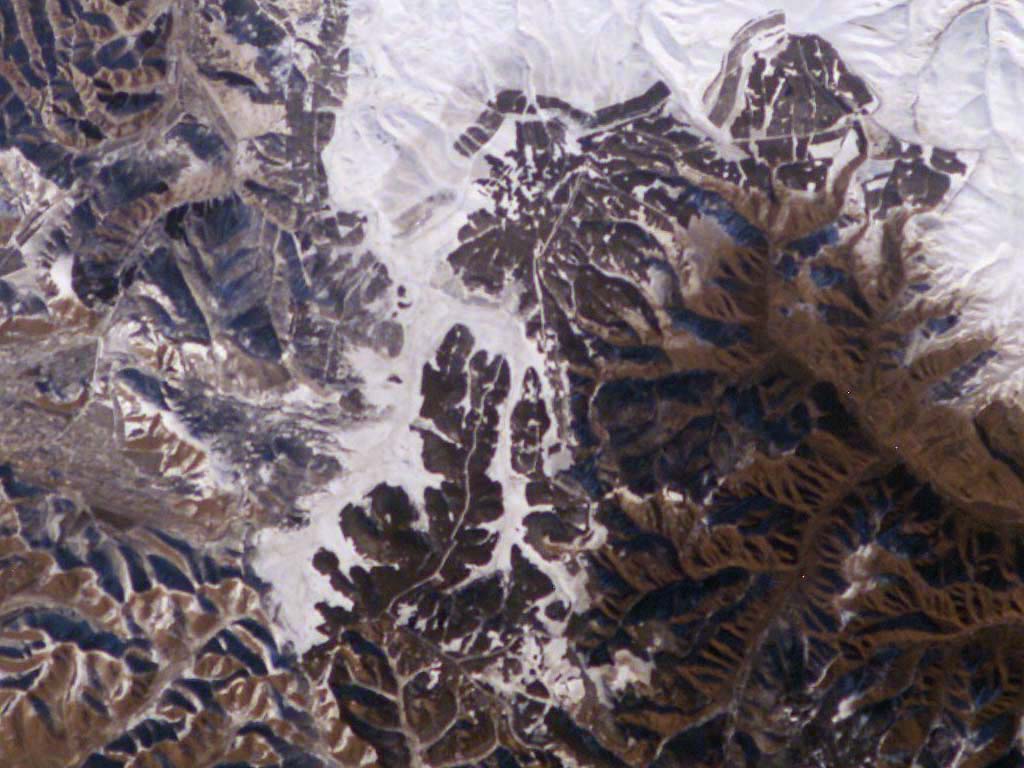
A satellite image of the Great Wall of China.
The Great Wall, visible as a black line
running diagonally through the image
from lower left to upper right
Image courtesy NASA/GSFC/MITI/ERSDAC/JAROS,
and U.S./Japan ASTER Science Team
From Wikipedia, the free encyclopedia

Desktop available 1024x768
(Source: spacedaily.com)

Great Wall of China Wallpaper:
Click the size you would like to download:
800 x 600 pixels—best for smaller monitors
1024 x 768 pixels—best for larger monitors
(Courtesy of © 1996-2008 National Geographic Society)

History of China
From Ancient China to Modern China circa 1988
by Leon Poon, University of Maryland

Political History of China
Beginnings and early history to modern era, circa 1988
by Leon Poon, UMD


Rupert Wingfield-Hayes, a BBC Beijing correspondent wrote on Wednesday, 30 July, 2003:
Most of the Great Wall of China is not as it appears on the television adverts and postcards.
Far from it. Most of the wall is in fact in a terrible state of repair.
It is overgrown, worn down by the elements and assaulted by locals who steal its stone.
In the last few years it has begun to be trampled too by hoards of hikers looking for a unique Great Wall experience.
Well, not any more, or so says the Chinese Government.
With nearly 3,000 kilometres of wall to choose from - most of it in remote, sparsely populated mountains - it is hard to see how local authorities are going to enforce their new ban.
The Great Wall of China is so spectacular that like the colossus at Rhodes and the Hanging Gardens of Babylon, it can be said to be one of the greatest wonders of the world. This is one of the largest manmade structures ever constructed and stretches across the mountains of Northern China surrounding the north and northwest sides of Beijing. The wall itself consists of masonry, rocks and packed earth.
Local villages and farms have used the great wall as a source of building materials over the last few centuries and as aerial photographs have shown, some sections of the great wall has only the top battlements still remaining, with the center of the wall being filled with sand and slit. Reconstruction and restoration of this amazing structure is, unfortunately, slow and problematic, as the same brutal conditions which originally made the Great Wall a triumph of engineering and determined planning are faced today.
(Copyright © 2007 China travel service itourschina.com)


(Image from great-wall-of-china.org)


A BRIEF HISTORY OF CHINA AND THE GREAT WALL:
With the continuous development of modern science and technology, we are learning more and more about the world we live in. We explore outer space to find out the secrets of the universe. We study our history to understand the stories that have taken place on the planet we live on. We try to learn to live in harmony with our environment, with other animals and plants. And most of all, we try to learn to live in peace with ourselves and with other human beings. Learning is an ongoing process for every individual as well as for all mankind. Based on what we currently know, below is a brief history of China and the Great Wall.

Chunqiu Period
770 B.C. - 476 B.C. In a divided China, many ducal states started to build walls along their boundaries.
Zhanguo Period
476 B.C. - 221 B.C.
Qin Dynasty
221 B.C. - 206 B.C. After unification, Qin linked and extended the walls of three northern states and formed the first Ten Thousand Li Great Wall (2 li = 1 km).
West Han Dynasty
206 B.C. - 25 A.D. Han further extended the Great wall to over 10,000 km.
East Han Dynasty
25 A.D. - 220 A.D.
Three Kingdoms Period
220 A.D. - 280 A.D.
West Jin Dynasty
265 A.D. - 316 A.D.
East Jin Dynasty
317 A.D. - 420 A.D.
South and North Dynasty
420 A.D. - 589 A.D. The states in the north continued to build the Great Wall.
Sui Dynasty
581 A.D. - 618 A.D. Sui also built the Great Wall.
Tang Dynasty
618 A.D. - 907 A.D.
Five Dynasties
907 A.D. - 960 A.D
North Song Dynasty
960 A.D. - 1127 A.D.
South Song Dynasty
1127 A.D. - 1276 A.D.
Yuan Dynasty
1271 A.D. - 1368 A.D.
Ming Dynasty
1368 A.D - 1644 A.D. Ming rebuilt the Great Wall, the length totalled over 6,000 km.
Qing Dynasty
1644 A.D. - 1911 A.D.
(Source: thegreatwall.com.cn)


Popular Posts